Marketing Automation: The Secret to Scaling Your Business
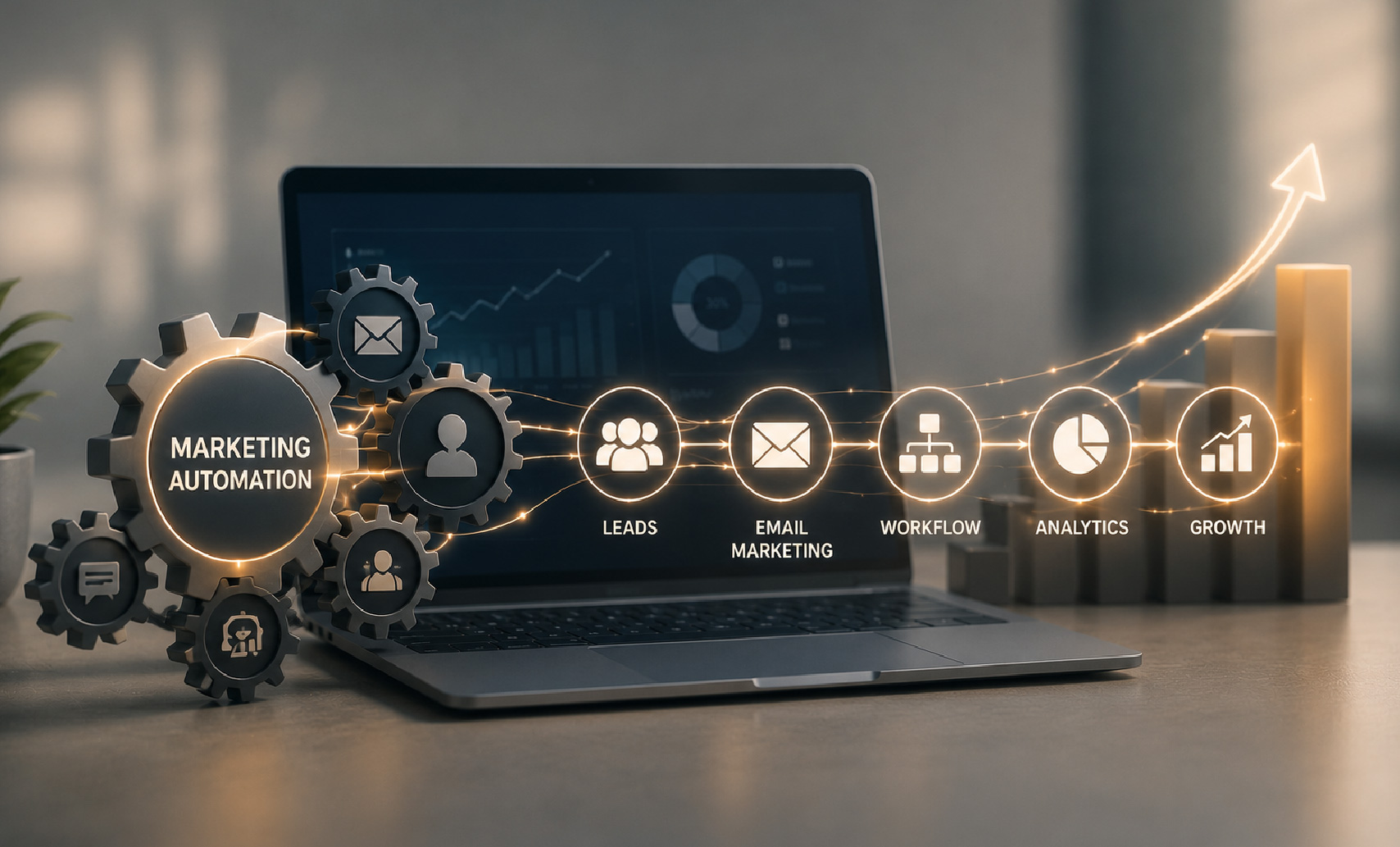
Marketing automation is the practical tool that helps brands grow without growing chaos. For agencies and businesses alike, automation turns repetitive tasks, email sends, lead qualification, campaign sequencing into predictable systems that work around the clock, so your team can focus on strategy and creative execution. When you pair automation with strong Brand & Communication and thoughtful Content Development, you get consistent experiences at scale and measurable results that matter.
What is Marketing Automation?
Marketing automation uses software to automate repetitive marketing tasks across channels, email, social, web, SMS and ads so the right message reaches the right person at the right time. Rather than manually chasing leads or scheduling posts, you design workflows that react to behaviour: someone downloads an asset, an automated nurture sequence begins; a shopper abandons a cart, an automated recovery flow triggers. This lets teams preserve a human touch while increasing throughput and accuracy. In simple terms, automation for marketing helps businesses stay consistent, save time, and communicate better across every stage of the customer journey.
How Marketing Automation Works
At a basic level, automation combines three things: data, rules, and content. Data flows in from forms, site behaviour, CRM fields, and ad platforms; rules determine triggers and routing, for example, lead scoring thresholds or cart-abandon triggers; content is the emails, landing pages, SMS or social assets that deliver value. Modern platforms integrate with Web & Mobile App and Performance Marketing systems, creating multi-channel journeys where every action can feed analytics and optimisation loops. This is why marketing and automation work so well together when businesses want faster results without adding more manual work.
Why it’s the secret to scaling
Automation scales outreach without scaling headcount. It reduces manual mistakes, shortens time-to-contact, and makes follow-ups reliable, so conversion rates rise while operational overhead falls. When automation is combined with strategic Channel Marketing and Strategic Sales Enablement, marketing becomes an engine that consistently feeds sales with qualified opportunities, not just raw leads. It also supports email automation at scale, making sure every message reaches the right audience with the right timing and purpose. For growing teams, that kind of structure is often the difference between slow progress and real scale.
High-impact workflows you can automate
- Welcome and onboarding series: Introduce your brand voice and core services, such as Employer Branding or Thought Leadership Marketing, immediately after sign-up.
- Lead nurturing and scoring: Use behaviour and firmographic data to move prospects through Content Development tracks and hand off only high-intent leads to sales.
- Abandoned cart and retention flows: Recover lost revenue with timed reminders, social proof, and incentives.
- Event triggers: Automate invites, reminders and post-event follow-ups for Event & Conferences to drive attendance and ROI.
- Cross-sell and upsell journeys: Trigger relevant offers via Performance Marketing after a purchase or milestone.
- Marketplace and channel alerts: Connect automated notifications for Marketplace Management Services or Channel Marketing updates so partners stay informed.
- Sales follow-up workflows: Use sales automation solutions to alert the sales team when a lead becomes hot, so no opportunity is missed.
- Pipeline management flows: Apply sales automation services to move leads from interest to conversion with less manual effort and better follow-through.
Mistakes to avoid
- Automating without a strategy. Automation amplifies what you do if your positioning and messaging (Brand & Communication) are unclear; automation will simply scale confusion. Start with mapped journeys and business goals.
- Poor data hygiene. Duplicate contacts, incorrect fields, and stale segments will break flows and hurt deliverability. Regularly clean and deduplicate your lists.
- One-size-fits-all sequences. Not every contact is at the same lifecycle stage, so use segmentation and lead scoring to personalise flows.
- Skipping analytics and testing. If you don’t track opens, clicks, conversion rates and revenue, you won’t know what to optimise. Test subject lines, CTAs, and send times to incrementally improve performance.
- Over-automating communications. Too many messages too fast can harm trust, space cadences sensibly and respect consent.
- Ignoring alignment between marketing and sales. When sales automation services are disconnected from marketing workflows, leads can drop through the cracks and growth slows down.
How to get started (5 practical steps)
- Map the buyer journey. Identify awareness, consideration and decision moments and where your services (Social Media Marketing, Video Production, Web & Mobile App) can add value.
- Pick the right platform. Choose a tool that fits your team’s scale and integration needs, look for CRM, analytics and ad-platform compatibility.
- Build three core flows: welcome/onboarding, lead qualification, and cart/re-engagement flows. These typically deliver the fastest ROI.
- Create modular content. Use reusable blocks and templates for emails, landing pages and social posts to keep messaging consistent and speed production.
- Measure and iterate.Track conversions, revenue per flow, and cost per lead; set weekly or monthly optimisation cycles.
- Connect marketing and sales.Build workflows that support marketing and automation together so leads are nurtured properly before they reach the sales team.
- Start with email automation.It is usually the easiest and most effective place to begin because it delivers quick wins and helps build trust with your audience.
How automation supports services and solutions
- Brand & Communication: Ensure consistent brand messages across automated touchpoints so every interaction reinforces identity and trust.
- Content Development: Feed automated workflows with tailored content downloadable, explainer videos, blog sequences to guide prospects down the funnel.
- Performance Marketing: Use automation to sync audience segments and behavioral signals with ad platforms for smarter retargeting.
- Event & Conferences: Automate invites, confirmations and post-event nurturing so every attendee receives timely, relevant follow-up.
- Employer & Recruitment Marketing: Automate candidate engagement and interview reminders to improve candidate experience and conversions.
- Thought Leadership & Sales Enablement: Deliver targeted thought-leadership content to decision-makers and trigger sales playbooks when leads show buying intent.
- Sales Automation Solutions: Use connected systems to score leads, route inquiries, and support faster conversions.
- Sales Automation Services: Help sales teams save time by automating repetitive follow-ups, reminders, and pipeline tasks.
Measuring ROI
Good ROI tracking ties workflows to revenue: attribute purchases or qualified opportunities to the automated flow that influenced them. Typical KPIs include conversion rate per flow, revenue per contact, cost per lead, and time-to-contact. Start by tracking micro-conversions (downloads, demo requests) and then map how many of those become revenue this makes it easier to justify platform costs and the labor saved. To get a clearer picture, compare performance before and after implementing automation for marketing and note how much time your team saves along with the increase in qualified leads. This makes the business case stronger and shows how marketing and automation together can deliver measurable growth.
Example
A mid-sized B2B company automated its content-driven nurture: a prospect downloads a whitepaper, receives a three-part email series that showcases product use-cases and thought leadership, and when the prospect clicks pricing, the system assigns a high lead score and notifies sales. Within three months, the company reduced sales cycle time by 20% and increased the qualified lead-to-deal rate without adding staff. This is a clear example of how email automation and sales automation solutions can work together to create smoother customer journeys and better conversion outcomes.
Scaling thoughtfully
Once core workflows are stable, expand into multi-channel journeys, adding SMS, push notifications, ads and in-app messages and use AI-assisted segmentation for predictive scoring. But scale one capability at a time, monitor results, and keep Brand & Communication consistent across channels. As your system matures, you can strengthen sales automation services and refine sales automation solutions so every lead is handled with speed and consistency. That is how modern businesses turn automation into a practical growth engine instead of just another software tool.
Conclusion
Marketing automation is the lever that multiplies your team’s efforts while preserving quality and consistency. When implemented with a clear strategy, clean data, and service-aligned content, especially Brand & Communication and Content Development, it becomes the engine that scales revenue and customer experience together. Start with a few high-impact workflows, measure their business impact, and expand into multi-channel journeys when you have reliable wins. With the right structure, email automation, automation for marketing, and marketing and automation can help a business grow smarter, faster, and more efficiently.