The Reason Why Most Websites for Business Fail to Generate Leads
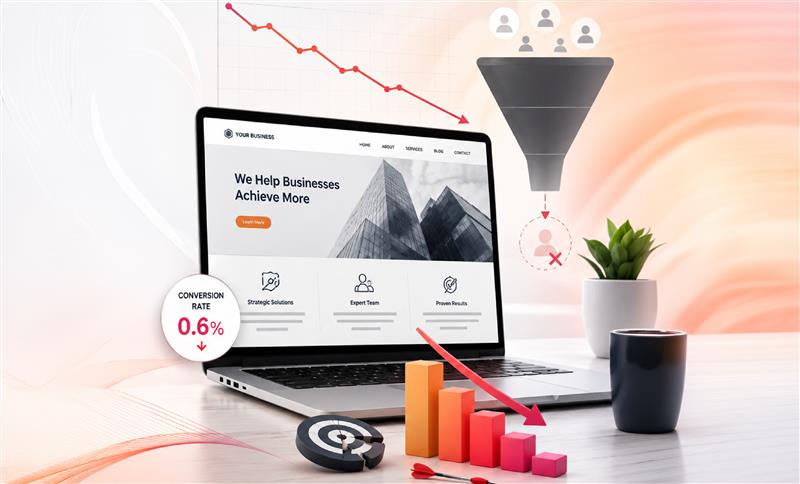
The website is one of the first places where customers encounter a company. They will most likely come to your site before deciding, whether they are searching for you via Google, social media, ads or referrals.
Many businesses invest time and money into their websites but still end up with a problem that they can't solve their site is attracting visitors but not leads.
A nice-looking website is not sufficient these days. A website shouldn't just be there; it should play an active role in converting your visitors into potential customers.
Websites are expected to be fast, user-friendly, and convey clear messaging and clear call to action for customers in 2026. When your website is lacking, visitors will probably exit and won't connect with you, arrange a consultation, or make a buy. Fortunately, many of the issues with lead generation can be solved.
Let's consider the primary reasons why business websites are not effective at lead generation, and what steps businesses can take to improve their results.
So, what are the elements that make a website so successful in generating leads?
But, before we can talk about the errors, we should first define what lead generation is.
A lead is someone who has expressed interest in your product or service in some way, such as:
A contact form is used to complete.
Booking a consultation
Requesting a quote
Downloading a resource
Registering for a newsletter
Calling your business
A website that spurs these actions is called a lead-generating website. The goal isn't simply to draw visitors in, it's to engage visitors as possible customers.
Unfortunately, many sites are simply concerned with design rather than conversion strategies.
- Unclear Messaging
Visitors do not act on a site because of one of the primary reasons: confusion. Upon visiting your site, visitors should be able to grasp something right away.
The services your company offers. The activities your company provides.
Who you help
What problem you solve
Why they should choose you
A lot of sites try to be clever or too creative, and this can result in communication breakdown. If they don't understand your business in seconds, they may lose their interest.
How to Fix ItBe brief and to the point with your message.
There should be a clear answer to this question on your homepage:
What your job is, and how you can assist them.
Conversions can be easily improved with strong headlines, clear service descriptions and simple language.
- No clear call-to-action (CTA)
Suppose you were to enter a store for which there was no employee to direct or assist you. This is like the situation when there are no direct calls for action on a website. Numerous business Web sites offer information but don't direct people to take the next step.
Visitors shouldn't have to second guess themselves on how to proceed.
Examples of Effective CTAsSign up for a Free Consultation
Get a Free Quote
Schedule a Demo
Contact Our Team
Download the Guide
Put your call to action on your website in prominent, visible spots. All major pages should call to action the reader to a certain response.
The easier you make the next step, the more likely you are to get visitors to convert.
- Slow Website Speed
The users today want websites to load almost instantaneously. Visitors won't endure a slow-loading website, they will go elsewhere and find another competitor.
Slow sites create poor user experience and can have a negative impact on search engine rankings.
Slow websites can be caused by the following:
Large image files
Poor hosting
Too many plugins
Unoptimized code
Outdated website infrastructure
Reduce website performance issues by:
Compressing images
Using quality hosting
Removing unnecessary plugins
Optimizing website code
Frequently checking site speed. Site speed testing regularly.
If your website loads faster, it will have a better user experience and improve lead generation.
- Poor Mobile Experience
A large percentage of all website visits are now mobile. But there are still a lot of business sites which give more focus to their desktop design and not mobile devices.
Optimizing your website for the laptop environment is great, but if it doesn't work well on a smartphone, you're losing out on a ton of leads.
Typical problems with mobile communications are:
Small text
Broken layouts
Difficult navigation
Slow loading times
Hard-to-click buttons
Follow a mobile-first strategy.
Make sure your web site is:
Responsive
Easy to navigate
Mobile-friendly faster to load than on desktop.
Optimized for touch interactions
But if they are unable to navigate your site on a mobile device, they are not likely to convert.
- No Trust Signals
No one wants to do business with an untrustworthy company.
Visitors are likely to look at your business before deciding to become your customers, closely checking if your business is legitimate and trustworthy. Sadly, some websites don't have sufficient evidence.
If they don't have the trust signals, they may not feel comfortable contacting your business.
Some examples of trust signals are as follows:
Client testimonials
Customer reviews
Case studies
Industry certifications
Awards and recognitions
Client logos
Success stories
Demonstrate your business' effectiveness.
Authentic testimonials and case studies can add a powerful element of credibility and inspire potential clients to act.
- Complicated Contact Forms
Many companies unknowingly erect barriers with their lengthy and complicated forms. The more you ask for initially, the less likely the people are to complete the form.
Visitors aren't going to fill out needless fields for several minutes.
How to Fix ItKeep forms simple. Only ask for this kind of information:
Name
Email
Phone number
Brief message
When friction is minimized, so is the conversion rate.
- Weak Content Strategy
Content is a key to lead generation. There are numerous sites that only sell, not giving any useful information.
Today's consumers tend to do their homework before they buy. Without informative content on your site, your visitors may not trust you as an expert and they will leave.
Valuable Content ExamplesBlogs
Industry insights
Guides
FAQs
Case studies
Resource pages
Develop content that will solve problems and answer questions.
This is an effective way to build trust and establish your business as an expert in the field.
- Ignoring SEO
Without Internet traffic, a web site is useless for lead generation. A significant number of businesses create a website and hope that the customers will find it.
Sadly, however, that isn't how online visibility works. If your website does not have SEO (Search Engine Optimization), it may be difficult for it to be found when people search online.
How to Fix ItWorking on the basics of SEO, such as:
Keyword research
Quality content
Technical SEO
Internal linking
Optimized page titles
Fast website performance
SEO brings in targeted traffic, thus boosting lead generation opportunities.
- No Lead Magnet
Many website visitors aren’t ready to purchase immediately. But they might be willing to give their details for a good reason.
Without lead magnets, businesses may not realize the opportunities for capturing potential customers.
Examples of Lead MagnetsFree eBooks
Industry reports
Checklists
Templates
Webinars
Free consultations
Free eBooks
Industry reports
Checklists
Templates
Webinars
Free consultations
Provide some benefit in return for contact details. This enables businesses to nurture leads until they're prepared to become customers.
- Instead of focusing on features, focus on benefits
Too many businesses talk about themselves too much. They publish features, services and technical details on their websites, without describing the benefits these features offer to customers. The most important element for visitors is the results.
They want to know:
How will this help me?
What is a problem that it addresses?
What do you think the outcomes will be?
Rephrase your message: from features to benefits. Rather than stating what you do, tell how you can help your customers' lives or businesses.
In its ability to communicate directly with customers' needs, benefit-driven messaging often converts better.
- No Conversion Tracking
One huge mistake that people make in the business is not monitoring the performance of websites. We can't say unless we have data:
From where do leads come to your website?
Which pages are generating leads?
To the point where visitors disembark
What is the top-performing CTAs?
What are the “best” CTAs?
Which traffic sources are converted?
Use tools like:
Google Analytics
Google Search Console
Heatmaps
Conversion tracking software
Data enables businesses to make well-informed decisions and continually enhance outcomes.
- Creating a Digital Brochure from a Website
The problem is that many businesses are still using their website as an online brochure rather than as a lead generation outlet.
A brochure provides information
A lead generation site is action driven. That is quite a difference. A successful website should take the visitor on a journey:
The order for changing behaviour is AIDA (Awareness-Interest-Desire-Action).
Each page should guide potential customers towards converting to actual customers.
How to Fix ItThink strategically. Focus on customer journeys, conversion goals, and user experience when designing your website, not just information.
How to Make Your Website a Lead Generator
Consistent business-lead generation from their websites generally have a few key principles:
Clear messaging
Strong CTAs
Fast loading speed
Mobile optimization
Trust-building elements
Valuable content
Conversion tracking
Not all the most successful websites are necessarily the most complicated.
They're just made to please the customer. All elements collaborate to facilitate the next step on the visitors' journey. With the ever-changing customer expectations, businesses need to be concerned with building websites that are user-friendly and conversion focused.
Successful websites in 2026 will be:
Fast
Mobile-friendly
User-focused
SEO-optimized
Trustworthy
Conversion-driven
Websites that are constantly optimized according to the users' actions and results will be at a huge advantage to their competitors.
No longer is a website just an online presence, now it is one of the most powerful lead generation tools a business can have.
Conclusion
Some businesses websites do not produce leads due to the fact they're not strategically planned. The messaging for visitors should be clear, there should be trust signals, they should be easily navigated, and there should be clear next steps. These elements are missing; potential customers leave without acting.
Fortunately, many of the problems on a web page can be resolved. Optimizing for the users' experience, conversion, content quality and building trust, can take a user's website from a passive online brochure to a powerful lead generation tool.
With so many websites competing for attention in the digital world these days, a site should not merely bring in traffic it should convert that traffic into profitable business opportunities.